I build the systems that let organisations scale, and then I get people to use them.
Most businesses outgrow their systems before they notice. I map what exists, design what should exist, build it, and stay until the new way of working actually holds. Seven countries, twenty people, four enterprise migrations, and a platform taken from requirements to production.
London, UK · Right to work in the UK to 2030, no sponsorship required
increase in annual enrolments, 200 to 1,500+
annual technology and operations budget owned
team led across engineering, data and support
enterprise platform migrations delivered
I build the systems that let ambitious organisations actually scale.
Six years across international education, high-growth consumer tech and consultancy. Trained as an architect first.
Most growing businesses hit the same wall. The way you operated in two markets does not scale to seven. The tools that worked when everyone sat together break down across time zones. The processes that felt fine at 20 people become the constraint at 100.
I trained as an architect in Nigeria and Germany before moving into operations, which is where the instinct for how systems fit together comes from. I pivoted at Getir during its German expansion, then led the operational and systems setup for a marketplace launch at Development Hub Consulting. I joined Study Now when it ran two countries on spreadsheets and built the technology and business systems function from nothing: four enterprise migrations, a proprietary admissions platform from requirements to production, an AI automation layer, and the reporting the leadership team now runs on. Seven countries, 1,500+ annual enrolments, a team of 20, a £500k+ budget, and the systems never became the bottleneck.
- MBAQuantic School of Business & Technology
- PMPProject Management Institute
- ITIL 4 FoundationAXELOS / PeopleCert
- Certified ScrumMasterScrum Alliance
- AI for BusinessWharton School, University of Pennsylvania
- Lean Six SigmaApplied in process optimisation
How I think about this work
Seven things I have learned the hard way. They explain most of the decisions I make.
A process nobody follows is worse than no process.
Weight of governance is not the same as quality of governance. The test is whether people use it without being chased.
Go-live is the halfway point.
Deployment and adoption are different things, and only the second one counts. Every change ships with a rewritten SOP, a named owner and a check months later.
Run the manual process yourself first.
Documentation tells you how a process is supposed to work. Doing it tells you where it actually breaks.
Holding a defensible no is what makes the yeses credible.
When demand exceeds capacity, the sequence has to be visible and the reasoning has to survive being argued with.
Automate the thing, do not absorb it into headcount.
If work is repeatable and growing, adding a person is a decision to keep paying for it forever.
Half the inefficiency lives in the handoffs.
Which is why putting every task in a swimlane and naming an owner surfaces more than the mapping exercise itself.
Build capability, do not centralise it.
If the process only runs when I am in the room, I have built a dependency, not a system.
The part most transformations skip
Most technology change fails after go-live, not before it. The system works, the training happened, and six months later people are back in the spreadsheet. Adoption is the part I am most interested in, and the part I measure.
Four enterprise platform migrations across 7 countries — Excel to Monday.com with 500+ agents trained, Google Workspace to Microsoft 365 with zero critical downtime, BambooHR across a 100+ person workforce, and Monday.com to a proprietary platform with workflows redesigned across every market.
Understand the work before redesigning it
I sit with the people doing the job and run the process myself. What the documentation describes and what actually happens are rarely the same thing, and the gap is where the real problem lives.
Design for the behaviour, not the diagram
A redesigned process has to be lighter than the one it replaces, or people will route around it. I map end to end, name the owner for every step, and cut anything that exists because it always has.
Ship with the adoption plan attached
Rewritten SOPs, training, a named process owner, and clear guidance for the teams inheriting new responsibilities. Not a launch email.
Measure whether it held
I come back months later and check. Adoption rate, exception volume, whether the old workaround has quietly returned. If it has, that is a design problem, not a people problem.
AI, specifically
I build with AI rather than talk about it, and I am precise about what that means. Here is the actual scope.
What I build
Production automation calling Claude via API across compliance tracking, partner management, financial reconciliation and operational reporting. Orchestrated with n8n, Make and Power Automate. Running daily, not piloted.
How I keep it honest
Model outputs are constrained to a defined schema. Nothing writes to a record unless a confidence threshold is met. Anything below the threshold, or above a value limit, routes to a human review queue instead of posting. I review that queue weekly and convert recurring patterns into deterministic rules, so the model's surface area shrinks over time rather than growing.
Tooling
Claude Code daily in both CLI and desktop, including custom markdown skills I author so repeatable analysis and operational work runs to the same standard across the team. MCP for tool connection. RAG where retrieval beats context stuffing.
Where I think AI is not the answer
Anything with a correct answer and a stable rule. Partial payments, duplicate transactions and threshold logic are deterministic problems, and using a model for them adds cost and removes certainty. The skill is knowing which half of the problem is which.
The model’s surface area shrinks over time, because every pattern I see twice stops being a model decision.
Products I have built from scratch
Identifying the problem is half the job. When no tool exists, or the ones that do are wrong, I build. These are shipped and in use.
GSP Platform
Built from scratch as the operational system of record for the business, serving both sides: the 500+ partner and agent network on the B2B side, and direct student applicants on the B2C side. Covers admissions, agent onboarding, commissions and compliance. Taken from business requirements and HTML prototypes through external development partner coordination, architecture decisions and acceptance sign-off on every release, then brought in-house by recruiting three software engineers. Now runs nine study destinations across the UK and Europe, each with its own application flow, visa regime and compliance rules on a shared core. Currently architecting the commission engine and rolling out AQF-compliant agent onboarding across 500+ partners.
Monday.com Operating Infrastructure
Designed and implemented Monday.com as the central operating infrastructure for the business, serving every department rather than a single team. Board architecture, workflow design, automation, permissions and reporting, with 500+ external agents trained onto it. The migration path into GSP was designed from it.
AI Workflow Automation Suite
Claude API, Claude Code, MCP, RAG, n8n, Make, Zapier and Power Automate, running across compliance, partner management, financial reconciliation, reporting and lead routing. Zapier acts as the interconnector across the wider tool stack, funnelling inbound leads into Monday.com and keeping systems in sync. Model outputs are constrained to a schema, nothing writes to a record unless a confidence threshold is met, and anything below threshold or above a value limit routes to a human review queue. Recurring patterns get converted into deterministic rules, so the model's surface area shrinks over time.
Custom Claude Code Skills
Custom markdown skills authored for Claude Code, used in both CLI and desktop, so repeatable delivery, governance and analysis work runs to a consistent standard across the team rather than depending on one person.

Deposit Tracker
Built to solve a real gap in visibility: where are student deposits sitting, across which institutions, and at what stage? A React and Supabase application tracking deposits across UK and international institutions, surfacing verified regional totals for the operations team.
Employee Voting App
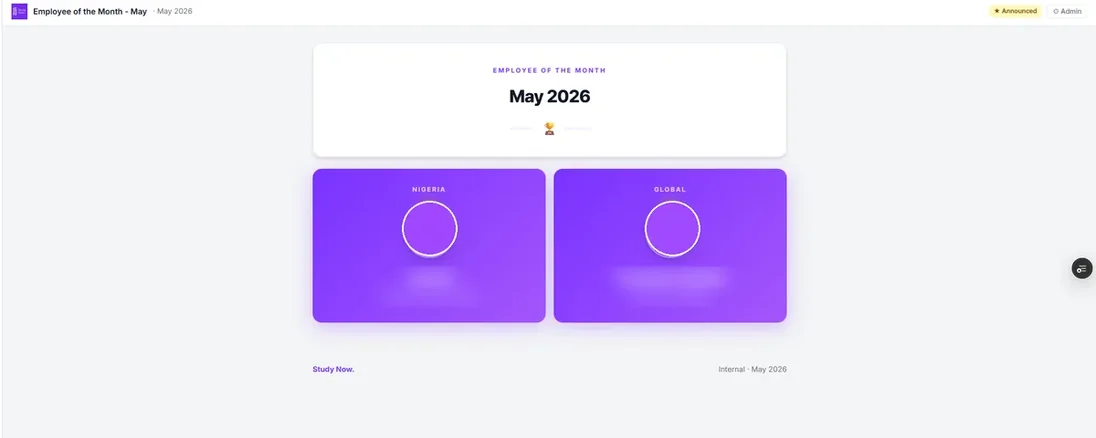
The HR team needed a governed, fair way to run Employee of the Month across two geographies. A React and Supabase application with separate Nigeria and Global voting tracks, role-based access control, and an admin portal the HR team configures monthly without developer involvement.
Shuqs
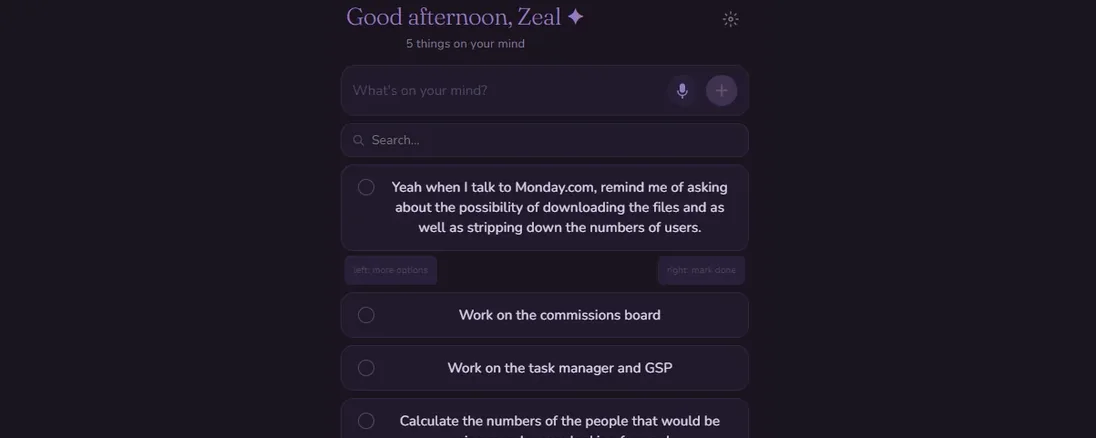
A full progressive web app built for personal use — three-screen onboarding, multi-select batch actions, Supabase authentication with cross-device sync, and push notification wiring. React Native parity built alongside the web version.
Isiro
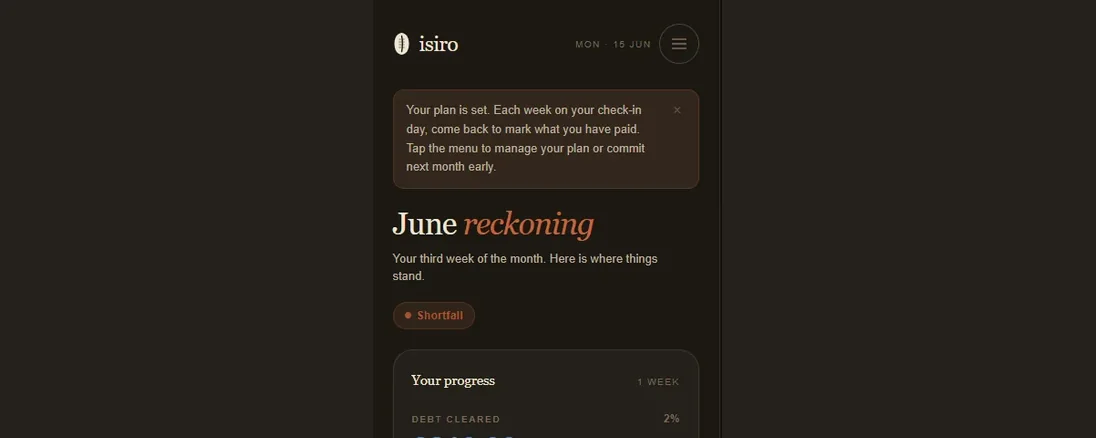
A personal finance PWA built around the Dabasir allocation principle from George Clason's writing — a structured approach to how money is divided across obligations, savings, and goals. Built on React and Supabase, deployed on Vercel.
From spreadsheets to seven countries
Two countries to seven, and a systems function built from nothing.
Where it started
Study Now operated across Nigeria and the UK, running core operations entirely on spreadsheets — approximately 200 annual enrolments, fragmented manual workflows, and no digital infrastructure to support growth into new markets.
Where it is now
Seven countries, nine offices, 100+ employees, 500+ global recruitment agents, 300,000+ student records, 1,500+ annual enrolments — running on a fully integrated enterprise stack that scaled through every stage of expansion without the systems ever becoming the constraint.
What I built at Study Now
- Monday.com implemented as central operating infrastructure — replaced Excel, every department, 500+ agents trained
- Proprietary GSP admissions platform — business requirements to live production
- Google Workspace to Microsoft 365 — full enterprise migration, zero critical downtime
- BambooHR implementation — 100+ person workforce, full audit readiness
- Monday.com to GSP migration — workflows redesigned across 7 countries
- AI-powered lead ecosystem (Element451 + GSP) — 50,000+ monthly interactions
- AI automation layer across compliance, partner management and finance, with human review gates
- Power BI intelligence dashboards — 300,000+ records, real-time executive visibility
- Release governance owned end to end after bringing production in-house
- IT department built from scratch — recruitment, structure, operating model
- Support department built from scratch — hired, structured and led as a new function
- OKRs and KPIs defined for the support function, with the reporting cadence to run against them
- Three software engineers and three data analysts recruited into capabilities that did not exist
- £500k+ annual technology and operations budget owned across all platforms
What I work with
- Microsoft 365
- Google Workspace
- Monday.com
- Element451
- BambooHR
- GSP (proprietary platform)
- Jira
- Confluence
- Asana
- Smartsheet
- Claude API
- Claude Code
- MCP
- RAG
- LangGraph
- OpenAI
- Microsoft Copilot
- n8n
- Make
- Power Automate
- Power Platform
- Zapier
- Power BI
- Tableau
- SQL
- Python
- Excel
- Airtable
- Webhooks & APIs
- TypeScript
- JavaScript
- React
- Next.js
- Node.js
- Supabase
- Vercel
- BPMN
- Visio
- Miro
- Revit
Thinking in public
Operations, technology, and the messy reality of building things that work.
Get in touch
If you are hiring for operations, delivery or transformation leadership, or you have an operational problem you want a view on, I would be glad to talk.